Reading a Cabinet Sample Door: Daylight, Edge and Back
A cabinet sample door tells you more than any swatch, if you know where to look. What to check in daylight, along the edge and on the back before you sign off.
· the kitchen guy
a sample door is a small, honest piece of the finished kitchen. a swatch or a screen image is a suggestion. the door is the real thing: real substrate, real finish schedule, real edge.
most people look at the face, nod, and set it in a closet. that wastes it. the face is the part we have the most control over. the edge and the back are where you learn how the cabinet will behave in year five.
here is how we read one, in the order we do it.
why a sample door beats a swatch
a finish chip is flat and tiny, and it is usually a different material from your doors. a sample door is built the way your cabinets will be, so it shows you three things a chip cannot:
- scale. a color that looks calm on a 3 inch chip can look loud across 14 linear feet of uppers.
- profile. a door with an applied molding or a bead throws shadow. a slab does not. the same finish reads differently on each.
- construction. joints, panel fit and edge treatment are visible only on a full door.
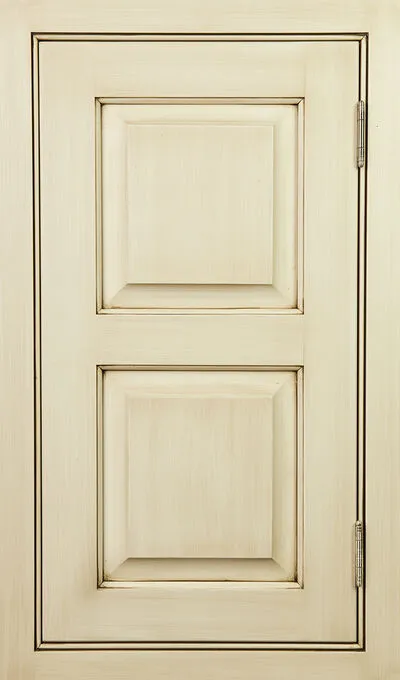
if you are comparing door styles, ask for the style you intend to use, not just the finish you like. a finish on a flat slab like Madison and the same finish on an applied-molding door like Gramercy Bevel will not look identical. the molding catches light and deepens the tone in the recesses.
step one: daylight, at three times of day
carry the door to the actual room. do not judge it under showroom spots or your phone flashlight.
stand it upright against the wall where the cabinets will go, not flat on the counter. vertical surfaces catch light differently from horizontal ones, and your doors are vertical.
then look at it three times:
- morning, around 8 to 9. a bright east window pushes a finish warmer.
- midday. this is your most neutral read, and the best moment to judge true color and grain.
- evening, with your actual bulbs on. this matters most. 2700K bulbs pull creams and woods toward yellow-orange. 4000K pulls them toward gray-green.
new york rooms make this harder. a north-facing pre-war kitchen onto an air shaft may get little direct light at all. a brownstone parlor floor with 11 foot ceilings and tall windows gets plenty, but it shifts hard from morning to afternoon. a loft with one wall of glass can wash out a finish by noon.
an off-white like Pearl is the classic test. in a bright south-facing room it reads clean and soft. in a shaded galley it can drift gray unless you check it against the trim and walls it will sit beside. hold the door next to your wall paint and your countertop sample. never judge it alone.
if you plan to use warm, high-CRI bulbs (90 and above), put them in a lamp near the door during your evening check.
step two: the face, grain and sheen
look at the face from two angles: straight on, then from a low raking angle, about 15 degrees off the surface.
straight on you judge color. raking shows you sheen, surface flatness and how even the finish is.
on stained wood
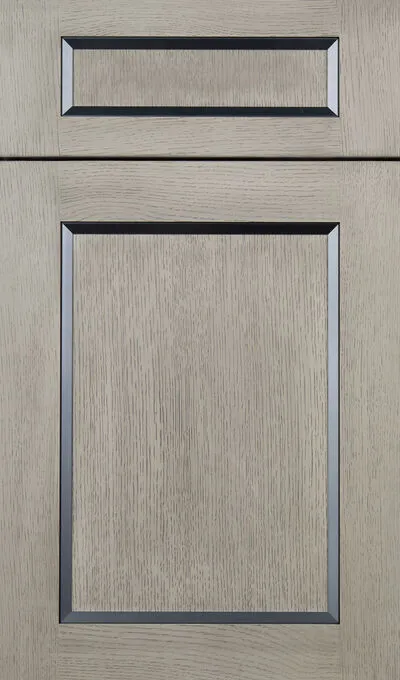
grain and mineral streaks are not defects. they are why you are paying for wood. what you want to know is the range. a single door shows you one board. ask whether the doors in your order will vary from it, and by how much. a dark stain such as White Oak Storm hides some variation but shows open pores and grain texture. a lighter natural stain shows more of the tonal movement from board to board.
on paint
look for orange peel, which is a faint dimpled texture, and for brush or spray lines. a good painted surface is flat and closed. run a fingertip over it. it should feel like glass, not like an eggshell.
on sheen
sheen changes color perception more than most people expect. a matte finish, roughly 5 to 15 gloss units, reads deeper and flatter. a satin finish, closer to 25 to 35, reflects window light and reads lighter. ask which sheen your sample uses, and be sure the door you approve is the one you will get.
step three: the edge, where finishes fail first
turn the door and look along the edge. a cabinet door is typically about 3/4 inch thick, and that narrow strip takes all the wear: hands, dish towels, the dishwasher door, a swinging stool.
check these points:
- corner radius. a razor-sharp corner chips. a slightly softened edge holds finish better. run a fingernail along it. you should feel no catch.
- coating thickness at the edge. on painted doors, finish thins at corners. look for a hint of the substrate color or a slightly lighter line at the arris.
- end grain. on stained wood, end grain drinks stain and goes darker. a well-finished door controls this so the rail ends do not look like dark stripes. view the top and bottom ends of the stiles for this.
- veneer edges. on veneer finishes like Rift White Oak, see how the edge is handled. the grain should run continuously and the edge should be closed and flush, with no visible lift or gap.
one more test. place the sample against your hand and rub the edge firmly with a damp cloth. a properly cured finish does not tack or transfer.
step four: the back tells you the build quality
almost nobody flips the door. it is where we flip first.
the back of a door is hidden on the installed cabinet, so it is the best place to see how a door is actually made. look for these:
- a sealed, finished back. an unsealed back absorbs moisture unevenly and can cup. new york swings from roughly 20 to 30 percent indoor humidity in a radiator-heated winter to 60 to 70 percent in an August without air conditioning. the door has to ride that out.
- balanced construction. front and back should be treated alike. a heavily coated face on a bare back is a warping risk.
- joinery you can see. on a framed door, look at the corners. tight, flush joints with no gaps are the sign of careful machining.
- floating panels. in a raised or recessed panel door, the panel sits free in its frame so it can move, often 1/16 to 1/8 inch across its width over a year. look for an even gap around the panel and no glue squeeze-out. if you see a thin line of unfinished wood on a stained door, that is the panel moving. it is normal, and a good finish schedule anticipates it.
- flatness. lay a straightedge across the back. a door that is flat on the sample table is the baseline for how flat your doors should be.
this matters most on inset cabinets, where the door sits inside the frame with a reveal of about 3/32 inch. there is very little room for a door to bow before you see it.
how to choose cabinet finish: a short routine
when people ask how to choose cabinet finish, we give them a routine rather than an opinion.
- take the sample home. stand it where the cabinets will be.
- look at it at 9 am, noon and 8 pm with your real lighting.
- place it next to your floor, countertop sample, wall color and any hardware finish.
- check the face raking, then straight on.
- run a fingertip along the edge and corner.
- flip it. look at the back and the joints.
- leave it for a week. look at it again when you are not trying to decide.
that last step does more than the rest. if you still like the door after a week of being in the room, it is the right one. if you find yourself walking around it, ask for another.
if you are torn between two, order both. the cost of an extra sample is small compared with a kitchen of cabinets in the wrong tone.
what a good sample should tell you
a sample door is not a promise that every door will be identical. wood is a natural material and painted finishes cure under real conditions. a good sample tells you the intent: the color, sheen, grain character, edge treatment and how it is built. ask us what range to expect and keep the door as your reference when the order arrives.
see it in person. request a sample door, or visit a showroom, and we will put the door in your hands, back first. request a sample door or showroom visit.
mentioned in this note
keep reading
Hiding the Microwave: Drawers, Lift Doors & the Pantry Option
A hidden microwave cabinet can be a drawer, a lift-door garage or a pantry shelf. Here is how each is built, what it needs, and which suits a New York kitchen.
Cabinet Touch-Up Paint: What a Kit Fixes and What Needs the Booth
A touch-up kit handles chips, nicks and small scuffs. Here is how to repair painted cabinets yourself, and when a door should go back to the finishing booth.
Custom Cabinet Lead Time: Why Inset Takes 10–14 Weeks
How long do custom cabinets take? Inset runs 10–14 weeks, frameless 8–10. Here is where the time goes and what you can order early.