Sustainable Kitchen Cabinets: What Actually Matters
Low-VOC finishes, FSC cores, formaldehyde limits and longevity. A plain-spoken guide to specifying sustainable kitchen cabinets for NYC homes.
· the kitchen guy
"sustainable" is the most overused word in kitchen showrooms. It gets stamped on door samples with no documentation behind it. Some of what it points to matters a great deal. Some of it is decoration.
here is how we separate the two when we spec cabinetry for apartments, brownstones and houses.
start with the air you actually breathe
a new kitchen is a sealed-box problem. In a pre-war co-op with one window and a vent that barely moves air, whatever off-gasses from the cabinets stays with you for weeks. That makes emissions the first sustainability question, ahead of anything about forests.
two things drive it: the board the box is built from, and the finish on the door.
formaldehyde: the number to ask for
the adhesives in panel goods are where formaldehyde comes from. U.S. federal limits (TSCA Title VI) cap emissions at roughly 0.05 ppm for hardwood plywood, 0.09 ppm for particleboard and 0.11 ppm for MDF. Those are the legal floor, and any compliant panel clears them.
better is plywood or core stock made with no added urea-formaldehyde (often labelled NAUF) or an ultra-low-emitting (ULEF) adhesive system. Ask for the label or the test report. If a showroom can't produce one, treat that as an answer.
what a low-VOC cabinet finish really means
VOCs, volatile organic compounds, are the solvents that leave a finish as it cures. A traditional solvent-borne lacquer can run well above 400 g/L. A good waterborne catalyzed finish typically comes in under 250 g/L, and some are far lower.
a low voc cabinet finish is a real upgrade, and it's not a compromise. Modern waterborne systems are harder than the old nitrocellulose lacquers. They resist yellowing on whites and light greys, and they hold up to steam, citrus and the cleaners people actually use.
three things to confirm before you sign off on a finish:
- the VOC figure in g/L, from the finish data sheet and not a marketing line.
- that it's fully cured before it ships. A finish can be low-VOC and still smell if it's boxed too early. Ask about cure time.
- that interiors are sealed too. Raw interior panels are a common emissions source that nobody thinks about.
on painted doors, a dark, deep colour like Iron shows every shortcut in the process, from film thickness to cure. It's a good test sample to hold up to the light.
FSC cores: useful, but know what the label says
the Forest Stewardship Council certifies that wood comes from forests managed to a documented standard, with chain-of-custody tracking from forest to finished product. That tracking is the part that matters. A certified core only counts if every handler in the chain is certified too.
know the label tiers:
- FSC 100%: all fibre from certified forests.
- FSC Mix: a blend of certified, controlled and recycled material.
- FSC Recycled: post-consumer or reclaimed content.
all three are legitimate. They're not interchangeable, so ask which one you're getting and ask for the chain-of-custody documentation. The same applies to ours. If you want certified cores specified for a project, tell us at the start. It can affect lead times and sourcing, and it's far easier to plan than to retrofit.
the cost is modest. In our experience, certified box material adds a low-single-digit to high-single-digit percentage to the box cost, and the box is only part of the total cabinetry budget. Door style, finish and hardware move the number far more.
the biggest lever: a kitchen that lasts
this is the part nobody puts on a sample tag. The most sustainable cabinet is the one you don't rip out in twelve years.
a well-built inset kitchen with dovetailed drawers, plywood boxes and a hardened finish can serve 30 years or more. A cheaper box that swells at the sink base, or a door that delaminates near the range, is a landfill item in a decade. Longevity beats any single eco-label.
what makes cabinetry last in New York homes:
- moisture resistance at the sink and dishwasher. Plywood sink bases and sealed edges handle a slow leak far better than particleboard, which swells and doesn't recover.
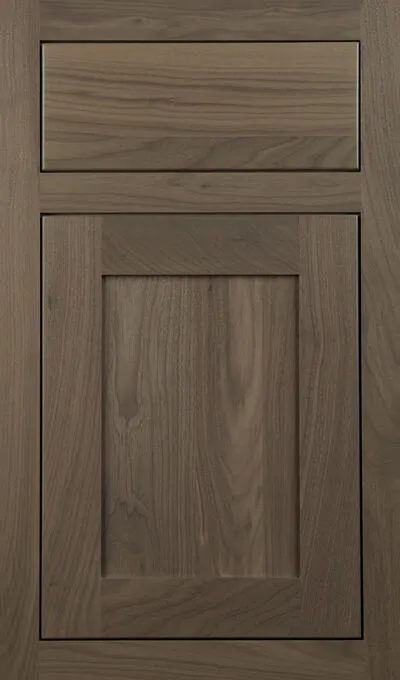
- stable door construction. Steam-heated pre-war apartments swing from very dry in January to humid in July. Solid-frame doors with proper joinery handle that movement. A style like Remsen is a good example of a simple frame that tolerates it.
- repairable finishes. Stain and paint that can be touched up on site mean a chipped door doesn't become a replacement door.
solid wood, veneer, laminate: no automatic winner
the honest answer is that each has a place.
solid and veneered hardwoods are renewable and refinishable. A quarter sawn white oak door can be sanded and re-coated decades from now. Veneer stretches a limited supply of premium timber across far more doors than solid planks would, which is a point in its favour.
laminates are durable and consistent, and they suit high-wear surfaces. The sustainability question is the substrate and adhesive, back to the formaldehyde number above.
the finish matters less than the build behind it. Choose by how the kitchen will be used, and then check the emissions paperwork for whichever you pick.
how to specify without getting greenwashed
if you're an architect or designer writing a cabinetry spec, or a homeowner comparing quotes, put these items in writing:
- formaldehyde rating of every panel, box and door core included, with the compliance or test documentation.
- finish VOC content in g/L, plus the cure time before delivery.
- FSC tier and chain-of-custody certificate number, if certification is required.
- the box material at the sink base and dishwasher run, named specifically.
- which finishes can be touched up on site, and with what.
for a small apartment, such as a West Village galley where the cabinetry runs 10 to 12 feet total, the emissions load is small and easy to manage. A 20-foot kitchen with a full-height pantry wall is a different volume of material, so the spec deserves more scrutiny. See how we think about West Village kitchens for the scale and detailing involved.
lead times for fully custom work generally run in the range of 10 to 16 weeks. Ask early about certified materials and finishes, since special requests are what stretch that window.
see it in person
samples tell you more than any label. We'll show you doors in our collections and walk you through the material and finish documentation, and you can smell a cured finish for yourself. Request a sample door or book a showroom visit in Manhattan or Cedarhurst, or by appointment in South Florida.
mentioned in this note
keep reading
Entertaining Kitchen Design: Second Sinks, Wine & the Off-Kitchen Bar
How to plan a kitchen with a bar area that works: second sinks, wine storage and a bar cabinet that lives outside the kitchen, with real dimensions for NYC homes.
Galley Kitchen Clearances: Aisle Width and Drawer Swing in NYC
Someone is always bent over an open drawer while someone else tries to get past. How aisle width, drawer depth and door swing decide whether a tight NYC kitchen works.
Kitchen Cabinet Ergonomics: Designing for Every Body at the Counter
Reach zones, aisle clearances, drawer heights and pulls that work for a six-foot dad and a five-foot grandmother. Cabinetry ergonomics for tight NYC kitchens.