Countertops for Serious Cooks: Quartzite, Marble & Porcelain
Honed marble, quartzite vs quartz, porcelain slab: what etches, what scorches, and what holds up to daily cooking in a New York kitchen.
· the kitchen guy
a countertop is the hardest-working surface in the house, and it sits on top of your cabinetry. the two have to be specified together. weight, overhang, reveals and edge profiles all depend on what you choose to cook on.
here is how the four materials we get asked about most actually behave when someone cooks every night.
first, understand etching
etching is not staining and it is not scratching. it is a chemical reaction. acid dissolves the surface of calcium-based stone, leaving a dull patch where the finish used to be. lemon, vinegar, tomato, wine and some cleaning sprays all do it.
marble is calcium carbonate, about 3 on the Mohs scale. it etches within minutes. true quartzite is metamorphosed sandstone, roughly 7 on the same scale, and is essentially silica. acid does not touch it.
that is the whole argument in two sentences. the rest is nuance, and the nuance is where people get burned.
honed marble: for people who cook and accept the patina
a honed marble countertop is matte, soft to the touch and quiet in a room. it is the surface of european pastry counters for a reason: it stays cool, and it is the best thing you can roll dough on.
the honed finish matters. on a polished slab, etches show as dull spots against a mirror. on honed, the whole surface is already matte, so etches blend into a gradual patina rather than reading as damage. in a pre-war co-op kitchen with original plaster and old wood floors, that aged look usually suits the room.
- etching: certain. wipe acid up fast and it fades, but expect marks.
- staining: oil and wine can sink in. seal with a penetrating sealer once a year.
- heat: excellent. a hot pan will not scorch it, though thermal shock can crack a thin slab.
- cost: roughly $80–$180 per square foot fabricated and installed, depending on the stone.
our advice: use it if you want it, and choose it knowing it will change. a client who says "i'll baby it" will be unhappy. a client who says "i love how old marble looks" will be fine.
quartzite vs quartz: not the same thing
the names are confusingly close, and the materials are opposites in how they are made.
quartzite
quartzite is natural stone, cut from a quarry. the better examples have the soft, veined look of marble with real hardness behind it. it resists etching, scratches only with effort and handles heat well.
the catch is labeling. some stones sold as quartzite are actually soft dolomitic marble or a mix. before you commit, ask the yard for an offcut and run two tests. leave a few drops of lemon juice on it for 15 minutes, then try to scratch a glass with a corner. a true quartzite shows no etch and scratches the glass. a stone that fails either one is not what the tag says.
expect $90–$250 per square foot installed. exotic slabs go higher. quartzite is also dense and can be brittle at the edges, so detailed profiles need care.
quartz
quartz is engineered: ground quartz, about 90–93%, bound with resin and pressed into slabs. it is non-porous, so it never needs sealing, and it does not etch.
its weakness is the resin. sustained heat above roughly 300°F can scorch or yellow the surface, and a pan straight off a burner can leave a permanent mark. use trivets. that sounds fussy until you cook on a range with 18,000 BTU burners. cost runs about $65–$140 per square foot installed.
for the short version of quartzite vs quartz: quartzite is natural and heat tolerant but needs a sealer. quartz is consistent and maintenance-free but is the one that fears the hot pan.
porcelain slab: the closest thing to indestructible
large-format porcelain is fired at very high temperatures, which makes it effectively immune to heat, acid, UV and stains. you can set a pot off the burner onto it without a thought.
slabs come in 6mm, 12mm and 20mm, and in sizes up to about 63 × 126 inches. the better ones carry the pattern through the body so a chipped edge is less obvious. cheaper printed slabs show a white core when chipped.
- etching: none.
- weak point: edges and corners. a heavy pot dropped on a thin edge can chip it. we specify a mitered or laminated edge of 20–30mm for the working run.
- cost: about $90–$200 per square foot installed. fabrication is specialized, so the shop matters more than the slab.
porcelain also has a practical advantage in older buildings. a 12mm slab is far lighter than 3cm stone, which is easier on old floors and on tight stair and elevator carries. a full-size slab still may not fit a walk-up, so ask about seams early.
what the countertop asks of your cabinets
3cm (about 1¼") stone weighs roughly 18–20 pounds per square foot. a ten-foot run is a few hundred pounds before anyone leans on it. the boxes underneath need to be square, level and fully supported, especially around sink bases where the stone has a large cutout.
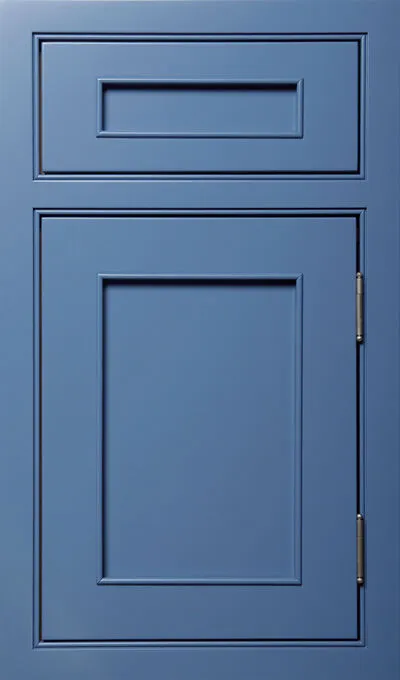
inset doors raise the stakes. with a 1/8" reveal around every door, the counter above has to be flat, and a floor that drops half an inch across a pre-war galley has to be scribed out. an overhang of 1–1½" is standard. thicker mitered edges need a matching cabinet-top allowance so drawers do not clip the stone.
pairing matters for looks too:
- a honed white marble on a Ink painted run is the classic high-contrast kitchen, and it handles imperfection well.
- quartzite with strong grey or gold movement works beautifully against Walnut Natural, which can absorb a busy stone.
- a quiet porcelain slab suits a clean slab door like Mercer, where the counter and the door plane do the talking.
working clearances do not change with the material. leave at least 15" of landing beside the cooktop, ideally 24" on one side, and keep the main prep run at 36" high unless the cook is unusually tall or short. in a tight West Village galley, a slightly deeper counter at 26" instead of 24" can add real prep space without touching the aisle. our West Village work covers exactly this kind of layout.
how we would choose
- you cook hard and want zero worry: porcelain, with a thicker edge, or true quartzite that has passed the lemon test.
- you love the look of marble and accept change: honed marble, sealed yearly.
- you want a uniform surface and never think about it: quartz, with trivets.
- a mix: honed marble on the island for baking and a harder material at the range. this is more common than people expect.
lead times matter too. plan on selecting the actual slab in person, then about 2–4 weeks from template to fabrication. slab-yard visits are worth the trip. photographs lie about veining, and the cabinet finish should be checked against the real stone.
see it in person
bring a stone sample and we will put it next to a real door. request a sample door or book a showroom visit in Manhattan or Cedarhurst, or by appointment in South Florida.
mentioned in this note
keep reading
Entertaining Kitchen Design: Second Sinks, Wine & the Off-Kitchen Bar
How to plan a kitchen with a bar area that works: second sinks, wine storage and a bar cabinet that lives outside the kitchen, with real dimensions for NYC homes.
Galley Kitchen Clearances: Aisle Width and Drawer Swing in NYC
Someone is always bent over an open drawer while someone else tries to get past. How aisle width, drawer depth and door swing decide whether a tight NYC kitchen works.
Kitchen Cabinet Ergonomics: Designing for Every Body at the Counter
Reach zones, aisle clearances, drawer heights and pulls that work for a six-foot dad and a five-foot grandmother. Cabinetry ergonomics for tight NYC kitchens.