Base Cabinet Drawers vs. Doors: Why We Spec Drawers
Drawers beat doors in nearly every base cabinet. Here is how we spec them for tight NYC kitchens: widths, depths, load ratings, and the few places doors still win.
· the kitchen guy
the short version: if a base cabinet is not holding a sink, a trash pullout or a corner, it should be a drawer stack. we spec drawers in roughly nine of every ten base cabinets, and we rarely get pushback once a client has opened one.
this is not a style preference. it is geometry, ergonomics and how cabinetry actually gets used in a kitchen that is 8 feet wide.
the problem with a door base
a standard base cabinet is 34.5 inches tall and 24 inches deep. behind a door, that is a dark box about 21 inches deep with one shelf. to reach the back, you crouch, empty the front, and reach in blind.
things migrate to the rear and stay there. the stockpot you use twice a year lives in the front. the one you use weekly is behind it. every kitchen we have walked through has a graveyard of lids and baking sheets at the back of a door base.
a drawer reverses this. you pull, and the whole 21 inches comes to you. nothing is behind anything else, and you see everything from above.
the galley math
pre-war co-ops and many brownstone parlor-floor kitchens are galleys, often with a 42 to 48 inch aisle between runs. a 24-inch door swings out about 15 to 18 inches at 90 degrees. in a 42-inch aisle, that leaves you a sliver to stand in while you crouch at the open door.
drawers need no swing clearance. the pull-out itself needs about 21 to 24 inches of travel, but it moves in line with you and doesn't block the aisle sideways. with two people cooking, this matters.
it also solves the dishwasher problem. an open door on a base next to a dishwasher collides with the dishwasher door. drawers never do.
how we build a drawer stack
not every drawer is equal. what we specify, and what we think you should ask for from anyone:
- full-extension, soft-close runners rated at 75 to 100 lb as standard, and 100 lb or more for pot and pan drawers. a 12-inch cast pot with water in it is heavier than people assume.
- box construction in solid hardwood or heavy-gauge sides with dovetail or doweled joints, not stapled thin panels. a drawer is a daily mechanical part.
- front adjustment in three axes, so fronts can be tuned after install against plaster walls and floors that are never level.
- sensible heights: 5 to 6 inches for the top cutlery or utensil drawer, 8 to 10 inches for the middle, and 12 to 14 inches for the deep bottom drawer.
the three-drawer base
our default for a 30 to 36 inch base is one shallow drawer over two deep ones. the top organizes utensils. the lower two take pots, pans, bowls and lids. a 36-inch width lets a 12-inch skillet sit sideways with room to grab the handle.
pot drawers under the cooktop
this is the single most valuable change we make. put 30 to 36 inches of deep drawers directly below the burners. pots, lids and oils sit where they are used. add adjustable pegs for lids and you eliminate the lid problem altogether.
what drawers do for inset cabinetry
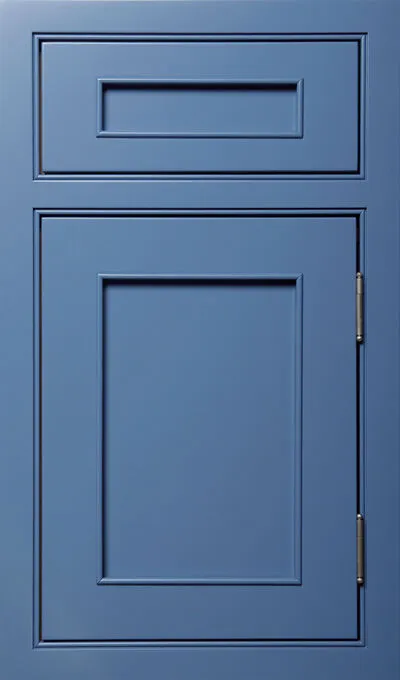
inset fronts sit inside the cabinet frame with a reveal of about 1/8 inch all around. drawers and inset suit each other. a drawer front is a fixed rectangle that moves straight out and back, so the reveal stays consistent. a door on a hinge can swing and shift with humidity, which shows up as an uneven gap over time.
in a stack of drawers, the reveals also line up horizontally across the whole run. in a flat, quiet design such as Mercer, that crisp grid is the whole look. in a Wooster Shaker kitchen, a wide drawer front gives the frame-and-panel profile room to read properly, where a narrow door can look cramped.
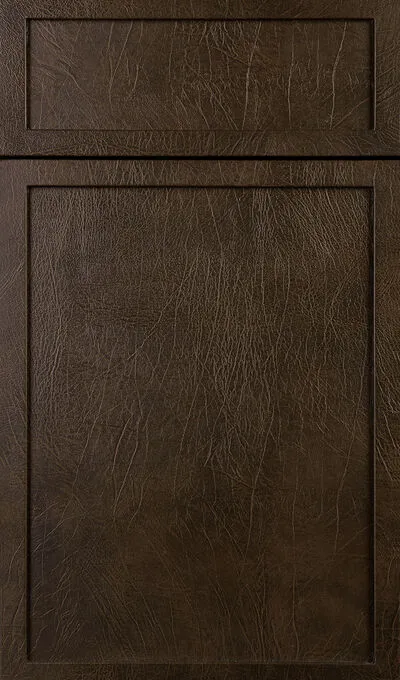
slimmer profiles like Spring Street Leather are especially good on wide drawers, since the thin frame does not fight the proportions of a 30 or 36 inch front.
grain, finish and why wide fronts matter
a drawer front is a larger, uninterrupted surface than a door, and it shows the material. in a veneer or stain such as Walnut Natural, we can run grain continuously across a stack of drawers so the figure reads like one piece of wood. with doors, grain breaks at every stile.
when we specify wood grain, we match the drawer fronts in sequence from the same panel wherever possible. it costs little in planning and is one of the quietest luxury details in a kitchen.
where doors still win
we are not absolutists. keep doors in these places:
- sink base. plumbing runs through it. a door base with a removable false front or a custom U-shaped drawer around the trap is the compromise, but a plain door is often the honest answer.
- corners. blind corners and lazy susans need a door. a good corner pull-out or susan is 32 to 36 inches and earns its space.
- narrow bases, 9 to 15 inches wide. a drawer this narrow is not much use. a door with a tall pull-out for oils, trays and spices works better.
- trash and recycling. a door-mounted pullout is a drawer in function, but the front is a door in construction.
- tall items. a door base with an adjustable shelf suits a few big, awkward things, like a stand mixer or a platter set.
cost, lead time and honest trade-offs
drawer bases cost more than door bases. expect roughly 10 to 25 percent more per cabinet, depending on the hardware and the interior. you are paying for runners, a box and an extra front, not a hinge pair and a shelf.
that premium is usually worth it. drawer bases hold far more usable volume, and they last. a quality set of runners will still glide quietly at fifteen years.
the one real trade-off is internal height. a drawer box eats a little vertical space for its runner and bottom, so you lose roughly 1 to 1.5 inches per drawer compared to open shelf space. for most households, easy access outweighs the lost inches many times over.
our practical rule: if someone will reach into it more than once a week, make it a drawer. if they won't, a door is fine.
if you want to see the full range of fronts that work with a drawer-first layout, browse all door styles and picture each one in a 36-inch width.
see it in person
the best argument for drawers is opening one. request a sample door or book a showroom visit in manhattan or cedarhurst (south florida by appointment), and we will put a loaded pot drawer in your hands.
mentioned in this note

keep reading
Loft Kitchen Design Around Cast-Iron Columns
Cast-iron columns are the best thing in a loft kitchen. Wrap them in an island or hide them in a run, and here is how the cabinetry has to be built.
Kosher Kitchen Design: Two of Everything, Done Elegantly
A kosher kitchen layout doubles sinks, dishwashers and storage. Here is how to plan the cabinetry so it reads as one calm room, even in a tight New York footprint.
Cabinet Hardware Trends: Scale, Mixed Finishes & Going Handleless
How to size pulls and knobs, mix metals without chaos, and decide whether handleless kitchen cabinets suit a pre-war NYC kitchen. Real numbers included.